Quick Answer
There are two different amounts: what the visa authority asks you to show and what you will actually spend. For the first year the living-cost evidence is about AUD 29,710 for Australia (roughly NPR 32.5 lakh), CAD 23,448 for Canada (about NPR 25.8 lakh) and £10,539 to £13,761 for the UK (about NPR 21.7 to 28.3 lakh), with tuition on top in every case. The Kathmandu embassy's pages state no euro figure for Germany, where €11,904 (about NPR 21.0 lakh) is the widely quoted blocked-account amount; figures verified 21 September 2026.
Last verified: 21 September 2026. Processing times and rules change, so each rule below names its source. Confirm the current position on the official page before you rely on it.
"February or July?" is the question most students ask. It is usually the wrong first question.
The better one is: which start date can I actually reach? An intake is a date on a university's calendar. Whether you can make it depends on a chain of steps that each take time, and some of those steps have official rules attached, from Nepal's Ministry of Education to a visa office in another country.
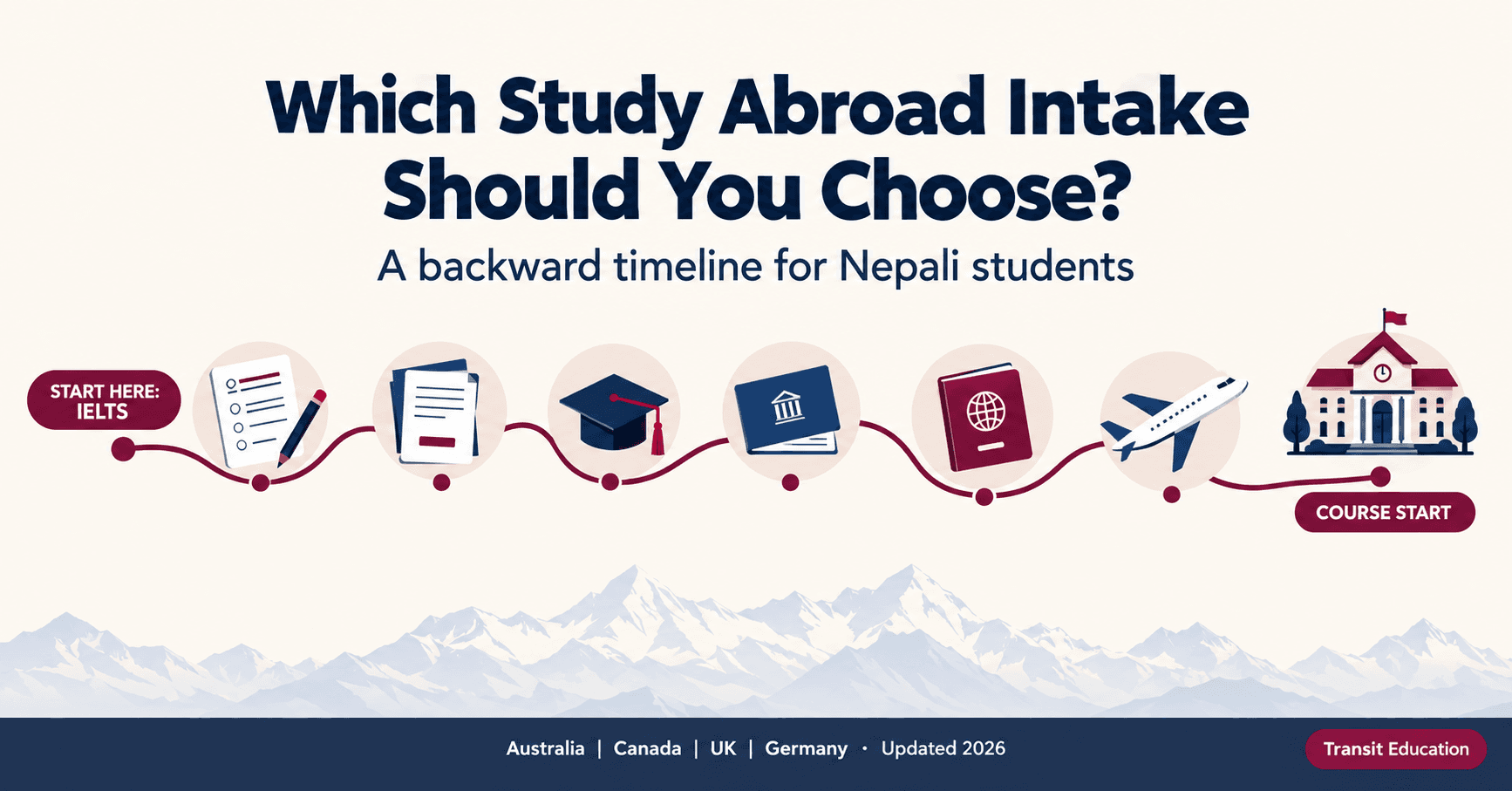
The short answer: the right intake is the first start date that is still ahead of you after you have completed every step and added the visa lead time. To find it, you count backward from the start date, not forward from today.
This guide shows how to do that for Australia, Canada, the UK and Germany, what the official pages say about timing, and where Nepali students most often lose weeks.
First, what an intake decision really depends on
Six things set the clock. Think of them as gates. You cannot pass the visa gate until the earlier ones are done.
Gate | What it means | What can slow it down |
|---|---|---|
1. English result | An accepted test score in hand | Retakes, test-date availability |
2. Academic documents | Transcripts, certificates, and the course entry requirements (check your grades with the GPA converter) | Requests for corrections, missing pages |
3. Offer and enrolment document | A confirmed offer, deposit if required, then the CoE (Australia), CAS (UK), admission letter (Germany), or PAL and acceptance (Canada) | Institution processing, deposit timing |
4. Funds evidence | Money in the form and for the period the country asks | UK 28-day holding rule, Canada's six-month statements |
5. Nepal-side approval | The NOC application through the Ministry of Education's portal | Documents, choice of institution |
6. Visa lodgement and processing | Applying, biometrics or appointments, medical or TB tests, then the decision | Priority level, document requests, appointment availability |
If you decide the intake first and discover gate 4 needs six months, you have chosen a date you cannot meet. If you start from the gates, the intake follows.
The steps that are specific to Nepal
English test results. IELTS says computer-delivered results usually arrive within 1 to 2 days, and paper-based results within 13 days. That is quick enough that the test itself rarely delays an application, but a retake can add weeks once you allow for test dates. The IELTS band calculator shows which countries a score may open.
The NOC. Nepal's Ministry of Education, Science and Technology runs an online No Objection Certificate portal at noc.moest.gov.np. The official user manual walks through creating an account with phone number, email and OTP, then filling in your passport details, prior education, and the country, institution, study level and subject you want. That last part matters for planning: the application asks for a target institution, so you need a shortlist before you start it. The manual we could read does not state fees or processing times, so do not rely on a number of days from a blog, and check the portal for current notices.
Funds evidence. Two rules affect when your money needs to be in place:
The UK requires funds to be held for at least 28 days in a row, ending within 31 days of your application date.
IRCC's Canada page lists bank statements for the past 6 months as one of the ways to prove funds.
Neither rule is about the amount alone. Both are about timing, which is why families who leave the funds question until the offer arrives often lose weeks. The amounts are covered in our companion article on proof of funds versus real cost.
Health tests for the UK. Nepal is on GOV.UK's list of countries where applicants coming to the UK for six months or more need a TB test. The test is a chest x-ray at an approved clinic, and the certificate is valid for six months from the date of the x-ray. Book it early enough that the certificate is valid on the day you apply.
What the official pages say, country by country
Australia
Full country guide: study in Australia from Nepal. For the application process itself, see our Australia student visa guide.
Study Australia lists the steps before you apply: letter of offer, Confirmation of Enrolment (CoE) after you accept and pay a deposit, English proficiency, the Genuine Student requirement, financial capacity, Overseas Student Health Cover, a possible health examination, the character requirement, then the online application through ImmiAccount. It also notes that concurrent CoEs are no longer issued, so you cannot hold Confirmations of Enrolment for several courses at once.
The most useful thing for planning is how the Department of Home Affairs decides processing order. For applications from outside Australia lodged on or after 14 November 2025, processing follows Ministerial Direction 115. Your priority level depends on your education provider's position against its enrolment allocation, and it is set at the time you lodge:
Priority | Who it covers (in summary) | Department's target to start processing |
|---|---|---|
1 | School, ELICOS, TAFE and doctoral students, government-sponsored scholars, and higher education and vocational students whose provider is below 80 per cent of its allocation | 1 to 4 weeks |
2 | Providers at 80 per cent of their allocation | 5 to 8 weeks |
3 | Providers exceeding their allocation by 15 per cent | 9 to 12 weeks |
The Department says these periods can change, particularly when lodgements increase, and that they are targets for starting to process, not a promise of a decision date. Even so, they change how you should plan. Two students applying for the same February start can face very different lead times purely because of their providers. Ask your admissions counsellor or your institution which priority applies to your course before you choose your date.
The Genuine Student requirement matters for timing too. The application form asks for short written answers (up to 150 words each) about your circumstances, your reasons for the course and provider, and how it helps your future. Drafting these well takes time, so start before the CoE arrives.
Australian intakes generally follow a semester pattern, with main starts in the first part of the year and a second start around July or August, and some providers offer additional starts. Not every course runs in every intake, so the calendar of the specific course decides.
Policy watch. On 17 September 2026 the Minister for Home Affairs announced that family members will no longer be attachable to student and graduate visa applications (with exceptions), and that students will only be able to progress upward through qualification levels. He noted that some parts need legislation and gave no start dates. If either affects your plan, such as bringing a spouse or starting at one level and moving to another, confirm the position when you apply.
Canada
Full country guide: study in Canada from Nepal.
IRCC's advice is to apply before you travel, and processing times for study permits vary by country, so use IRCC's processing times tool for Nepal on the day you plan. The bigger timing factor is the provincial attestation letter (PAL) or territorial attestation letter (TAL):
Most applicants need one, and it comes from your designated learning institution.
It must be submitted with the study permit application, not afterward.
Master's and doctoral students at public designated learning institutions do not need one from 1 January 2026.
A PAL issued in 2026 is valid until 31 December 2026, and you cannot apply with a PAL issued in a previous cap year.
That last rule creates a calendar trap at the turn of the year. A student aiming for a January 2027 start who has a 2026 PAL needs the permit application in before 31 December 2026. If the application slips into January, a 2026 PAL cannot be used, and a new one from the 2027 cap year would be needed. Ask your institution how it handles this. Do not assume a PAL can be carried across.
Also plan the funds evidence early. IRCC's page lists bank statements for the past 6 months as one form of proof, so the money needs to be visible in your account that far back when you apply, unless you use another form of evidence such as a GIC or a bank education loan letter.
Canadian institutions commonly offer fall (September) and winter (January) starts, with some programs offering others. Confirm each program's calendar.
United Kingdom
Full country guide: study in the UK from Nepal.
GOV.UK sets clear windows. You can apply as early as 6 months before your course starts, and a decision usually takes 3 weeks if you apply from outside the UK. The 3 weeks is a typical figure, not a guarantee, and it starts when you have completed your application steps.
The steps that consume time before that:
The Confirmation of Acceptance for Studies (CAS) from your university.
Funds held for 28 days in a row, ending within 31 days of application.
A TB test at an approved clinic, if you are staying six months or more (valid six months from the x-ray).
Payment of the Immigration Health Surcharge as part of the application.
UK universities commonly recruit for September and January starts, with the exact options varying by university and course.
Germany
Full country guide: study in Germany from Nepal.
The German Embassy in Kathmandu states that processing takes approximately 3 to 4 weeks at a minimum, and applications are made through the Consular Services Portal, where documents can be amended before the embassy appointment. Two Nepal-specific points can affect timing:
Language certificates. The embassy says certificates are recognised only from the Goethe Center Kathmandu, VHS (three locations) or telc, and must be presented with the visa application. They cannot be handed in afterward. If your program needs German, build the language exam into the calendar first.
Documents. Documents not in German or English need certified translations.
The visa fee is €75 equivalent, paid in NPR in cash. The embassy checklist also warns that additional documents can be requested during the process, so leave room.
German universities usually run a winter semester starting in autumn and many also a summer semester in spring. Application deadlines and requirements vary by university and program, so check the program page. The DAAD database is the usual place to start.
A backward timeline you can copy
Count back from the first day of your course. The "rule" column shows what an official source says. The "suggested" column is our planning suggestion, not an official figure.
Months before start | Step | Rule | Suggested planning |
|---|---|---|---|
12 to 10 | Shortlist countries and courses by budget | none | Do the funding arithmetic first, using the proof of funds article |
10 to 8 | Sit the English test; start applications | IELTS results in 1 to 2 days (computer) or 13 days (paper) | Leave time for one retake |
9 to 7 | Start the NOC application once you have a target institution | Portal asks for country, institution, level and subject | Gather passport, transcripts and offer details |
8 to 6 | Receive offers; accept one; pay the deposit if required | Australia: no concurrent CoEs | Decide before deposits, not after |
6 to 4 | Confirm funds are in the right form and period | UK 28 days; Canada statements for past 6 months | Move and document funds now, not in the week of application |
5 to 3 | Enrolment document (CoE, CAS, PAL or admission letter) | Canada PAL tied to a cap year | Check the PAL year and provider priority now |
4 to 2 | Health tests and visa lodgement | UK: TB certificate valid 6 months; apply up to 6 months early | Book TB test and biometrics or appointments first |
3 to 1 | Visa decision | UK about 3 weeks; Germany 3 to 4 weeks minimum; Australia 1 to 12 weeks to start processing by priority | Assume the slowest case for your provider |
1 to 0 | Accommodation, flights, insurance, pre-departure | none | Book flights after the visa decision, not before |
A rule of thumb from us, not an official rule: take the longest official time for your country and add a month for document requests and appointment availability. For an Australian applicant at Priority 3, that means planning for roughly 16 weeks from lodgement before you can expect movement.
If you want your documents checked against this calendar, ask about the student visa service.
If you are reading this in autumn 2026
These readings come from the dates and official rules above, plus the assumption that your university has a start date to match. They are not guarantees.
Australia, first-semester 2027 start. You are within a normal planning window. If your course starts in late February and your provider is at Priority 3, the Department's 12-week target to start processing points to lodging by about early November, and earlier is safer.
Canada, January 2027 start. Very tight, and it depends on a 2026 PAL and on lodging before 31 December 2026. If you have not started, September 2027 is the more realistic target, with a 2027 PAL.
UK, January 2027 start. The application window is already open, since it starts 6 months before the course, but you also need a CAS, funds held for 28 days, and a TB test. If any of these has not started, plan for the next intake.
UK or Canada, autumn 2027 start. You have time. Use it for the funds and documents gates, which are the ones that cannot be rushed.
Germany. Check the application deadline for your specific program first. Deadlines and language requirements differ by university.
Six mistakes that cost Nepali students an intake
Choosing the intake before checking readiness. The month is the last decision, not the first.
Starting the funds evidence when the offer arrives. The UK and Canada rules are about how long the money has been in the account.
Expecting several CoEs to stay open. Australia no longer issues concurrent CoEs, so you have to choose.
Ignoring the PAL year. A PAL from the previous cap year cannot be used.
Leaving the TB test or language certificate to the end. Both must be valid and in hand when you apply.
Trusting old timelines. Processing priorities changed for Australian applications from 14 November 2025, and announcements as recent as 17 September 2026 may change details further.
Choosing between two intakes: a quick test
If you are torn between two start dates, answer these five questions for each:
Will my English score be in hand at least four months before start?
Will my funds meet the country's timing rule by then?
Will my offer and enrolment document be issued in time?
Do I know my provider's Australian priority or my Canadian PAL status?
Do I have enough time to fix one problem, such as a missing document, without losing the intake?
Choose the earlier intake only if you can answer yes to all five. If one answer is no, the later intake is not a defeat. It is the one that fits the gates, and rushing an application is the more common way to lose a year.
Frequently asked questions
Does Australia have a July intake?
Many Australian providers run a second-semester start around July or August, but not every course does. The course calendar decides, so check the specific program.
When can I apply for a UK student visa?
As early as 6 months before your course starts, if you apply from outside the UK. GOV.UK says a decision usually takes 3 weeks. Have your CAS, your funds evidence and a TB test certificate ready first.
How long does the Australian student visa take?
The Department gives targets for starting to process, not for the final decision: 1 to 4 weeks for Priority 1, 5 to 8 weeks for Priority 2 and 9 to 12 weeks for Priority 3 for applications lodged from outside Australia since 14 November 2025. It also publishes a processing time guide tool. Your priority depends on your provider.
Do I need a PAL to study in Canada?
Most applicants do. Master's and doctoral students at public designated learning institutions are exempt from 1 January 2026, and there are other exemptions. The PAL must be submitted with the permit application, and it must be from the current cap year.
How long are IELTS results?
IELTS says results are usually available within 1 to 2 days for the computer-delivered test and within 13 days for the paper-based test.
Do Nepali students need a TB test for the UK?
GOV.UK lists Nepal among the countries where a TB test is needed for visa applications for stays of six months or more. It must be done at an approved clinic, and the certificate is valid for six months from the x-ray.
How long does the German student visa take?
The Kathmandu embassy says approximately 3 to 4 weeks at a minimum. Add time for the language certificate if your program needs one, since it must be submitted with the application.
The next step
You now have the shape of the calendar. What is still unknown, and what changes the answer, is your own position: whether your English score is enough, whether your documents are ready, whether the funds will meet the timing rule, and which provider priority or PAL year applies to your shortlist.
That is a short conversation, and it is best had before you commit to an intake. Book a free profile review with Transit Education, and bring three things: your IELTS or PTE score (or your planned test date), your latest academic transcripts, and the intake or two you are considering. Ask the counsellor to build a backward calendar for each intake, flag the gate most likely to slip, and check the current official rules for your country. If your English score is the gate, Transit Education runs IELTS and PTE preparation classes in-house, and the IELTS band calculator on the site shows which countries a score may open.
You can visit our Kathmandu, Itahari, Damak or Damauli office, or start by WhatsApp.
Information in this article is general guidance based on public government sources on the date above. It is not legal or immigration advice, and requirements can change. Always confirm current requirements on the official website of the relevant authority before applying.
Frequently Asked Questions
Is a 3-month bank statement enough for a student visa?
Is NPR 20 lakh enough for Germany?
Which country is cheapest for Nepali students?
Does an education loan count as proof of funds?
Can I use money I plan to earn from part-time work?
Sources & References
- https://www.studyaustralia.gov.au/en/plan-your-move/your-guide-to-visas/student-visa-subclass-500
- https://www.studyaustralia.gov.au/en/tools-and-resources/news/student-visa-application-charge-increase
- https://www.studyaustralia.gov.au/en/plan-your-move/visa-application-process
- https://www.studyaustralia.gov.au/en/life-in-australia/living-and-education-costs
- https://immi.homeaffairs.gov.au/visas/getting-a-visa/visa-listing/student-500
- https://immi.homeaffairs.gov.au/help-text/evidence/Pages/et-h0185.aspx
- https://minister.homeaffairs.gov.au/TonyBurke/Pages/speech-national-press-club-17092026.aspx
- https://www.canada.ca/en/immigration-refugees-citizenship/services/study-canada/study-permit/get-documents/financial-support.html
- https://ircc.canada.ca/english/information/fees/fees.asp
- https://www.canada.ca/en/immigration-refugees-citizenship/services/study-canada/study-permit/get-documents/provincial-attestation-letter.html
- https://www150.statcan.gc.ca/n1/daily-quotidien/250910/dq250910d-eng.htm
- https://www.gov.uk/student-visa/money
- https://www.gov.uk/student-visa/how-much-it-costs
- https://www.gov.uk/healthcare-immigration-application/how-much-pay
- https://www.gov.uk/tb-test-visa
- https://kathmandu.diplo.de/np-en/service/01-visaeinreise/2225320-2225320
- https://kathmandu.diplo.de/resource/blob/1788692/b9b4dfbe10df74e88aa11e36364d9721/student-visa-checklist-data.pdf
- https://kathmandu.diplo.de/np-en/sperrkonto/388600
- https://www.auswaertiges-amt.de/en/visa-service/buergerservice/faq/08-finanzierung/606696
- https://www.immigration.govt.nz/process-to-apply/applying-for-a-visa/providing-evidence-and-documents-to-support-your-visa-application/student-fund-requirements/
- https://travel.state.gov/content/travel/en/us-visas/visa-information-resources/fees/fees-visa-services.html
- https://study-uk.britishcouncil.org/moving-uk/cost-studying
- https://www.x-rates.com/historical/?from=NPR&amount=1&date=2026-09-19